Welcome! I’m Carolyn Dube – This colorful journey is all about the freedom of play!
Search My Blog
Search by Category
The Fine Print
Some of the links on this blog are affiliate links and I receive a small percentage. It doesn't cost you anything extra and helps keep all the free tutorials and videos coming! It's a win-win!
The website is copyright Carolyn Dube, and that is kinda common sense since this is my site.
As an Amazon Associate I earn from qualifying purchases.
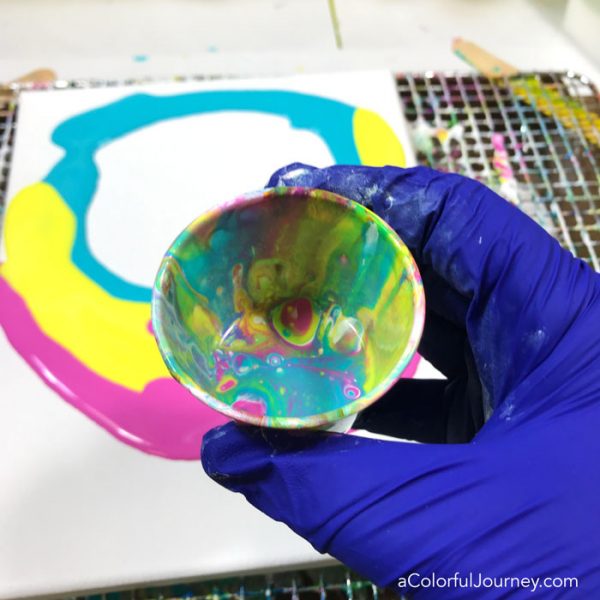
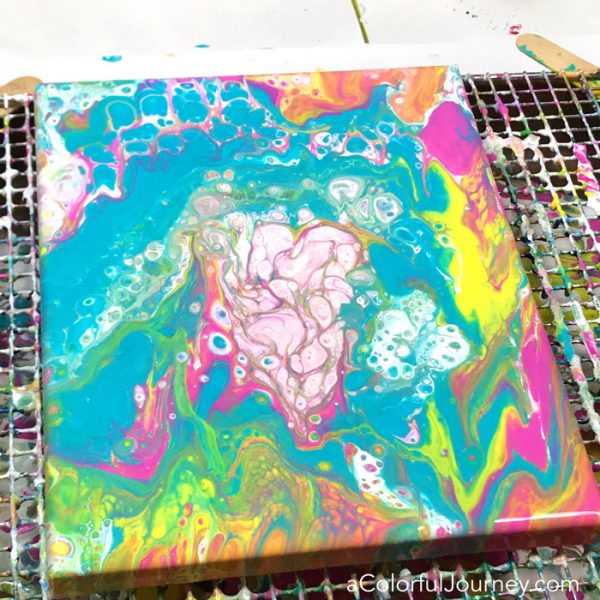
The leftover paint in the bottom of the cup from a dirty pour is an invitation to make another canvas. Plus it feels criminal to not use that gorgeous color mingling in the cup. So I just have to make another canvas. Can you see the muse twisting my arm and forcing me to play?
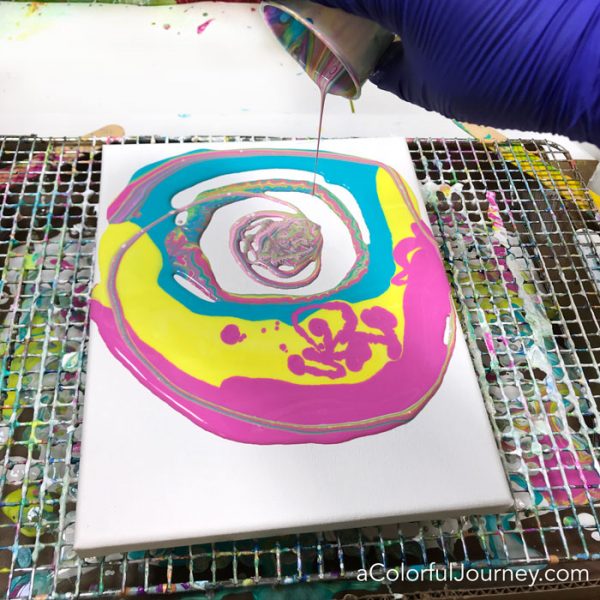
But there isn’t nearly enough in there to cover a canvas. Problem? Nope. An opportunity to use up the remaining solid colors in the cups. Will there still be cells and colors moving around? You bet thanks to gravity and a palette knife.
How was the paint mixed? What was added it? What is that thing the canvas is sitting on? It’s all explained along with everything you need to make your first pour in this video.
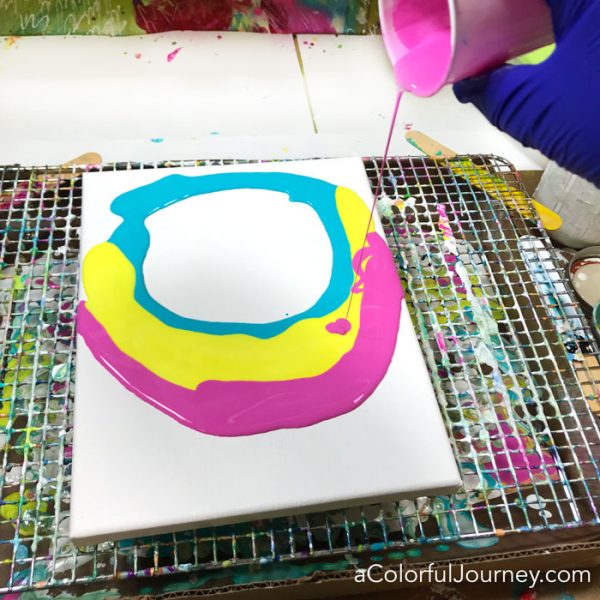
It looks like there is a grand plan but there isn’t. The goal is to just use up all the paint in the cups on the canvas. It might start looking like this, but it will change a lot before it’s done.
The solid colors are nice but the magic is in the dirty pour leftovers in the cup. Where did those dregs in the cup come from? You can see how the colors were added to the cup and the canvas it made here.
No plan here, just having fun dripping that color all around the canvas. But it won’t be enough paint. Reinforcements will have to be brought in – white paint added to the areas that didn’t have enough.
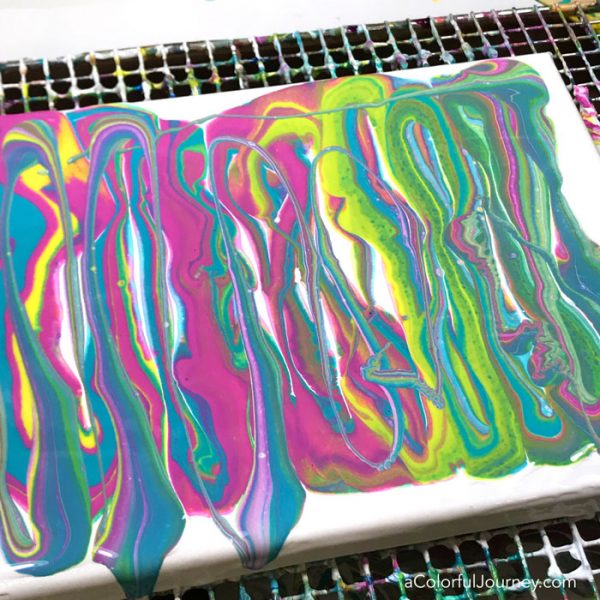
How did it go from the solid areas of color to the cells and pattern below? Gravity. By tipping the canvas, the paint ran. To help it along, swipes were made with a palette knife. You can use anything to swipe with, so whatever you have will do the job. The video shows it far better than words can- click here to jump to this part of the video.
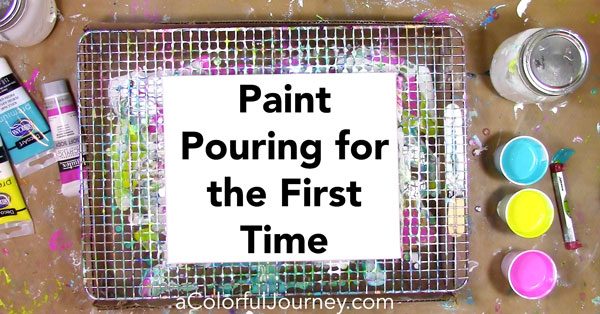
If you can pour paint out of a cup and can tilt a canvas, then you have all the necessary skills to make a colorful piece of art to hang on your wall with paint pouring. We’re going to unleash the rainbow using just 3 colors plus white.
In the video, I’m sharing how to set up your space so not a drop of paint gets wasted, the easy way to know if you have the right ratio of paint to pouring medium, and everything you need to know to make your first pour. At the end of this post, there is a supply list along with reminder notes for your reference.
To help you get started, I’ve created a free Paint Pouring Guide that guides you through the entire process- from the best pouring medium for getting cells when you’re starting out, which of your paints are best for pouring, and much much more. Download it now so it’ll be at your fingertips whenever you need it.
Getting Ready to Pour
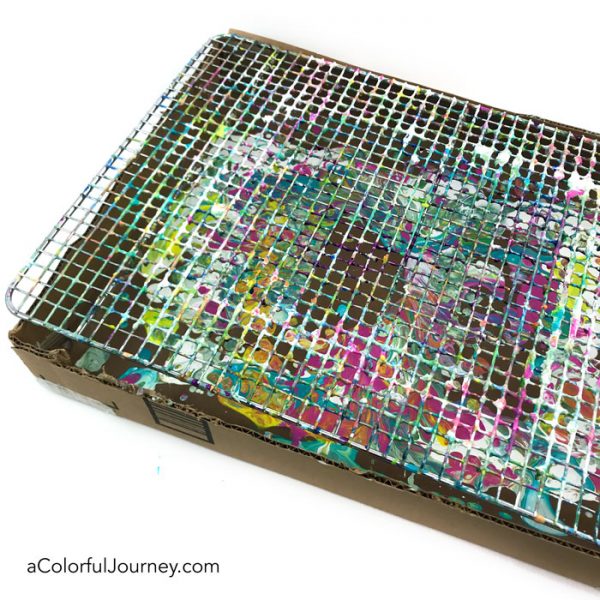
Drips happen with paint pouring so you need something to catch the drips. My favorite is a cardboard box with a cooling rack from the kitchen section. On the bottom of the box is an inexpensive teflon sheet so when the paint drips in there it becomes a colorful paint skin that just peels it up when it’s dry.
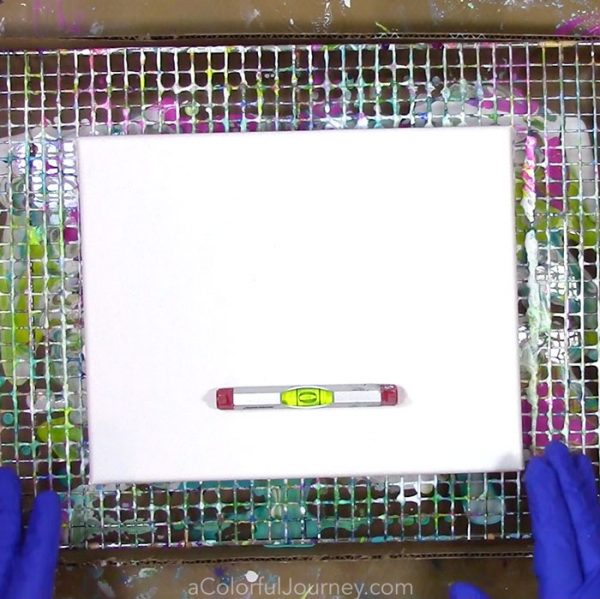
Level your canvas as best you can. I am clearly not an engineer, so about level is the best I can do. If you’ve never used a level before, you want the bubble to be between the lines. Check multiple places on the canvas and if you find it isn’t level, us something like a popsicle stick to shim it up until it’s level.
Mixing the Paint and Pouring Medium
Is there one perfect pouring medium? Nope. There are many to choose from and they each have their pros and cons. Floetrol is the one I recommend for your first pour because of how it moves and behaves, plus it’s the least expensive one too. It’s actually a contractor supply so you can get it at hardware stores and online.
When I started I did a lot of careful measuring as I figured out the “perfect” ratio of paint to pouring medium. And guess what, it didn’t make a bit of difference. What I found was that if I had a tube, just over 2 oz. of the Americana premium acrylics to 3/4 cup to 1 1/4 cup it all behaved the same for me. When I used Liquitex soft body paint, I used less paint, about a third of a 2 ounce tube.
Color was the best indicator of how happy I would be with the mixture. As long as it looked like the color in the tube, I would be good. So when I mix the paint, if it looks lighter than what comes out of the tube, I add more until it matches.
Air bubbles are the enemy of paint pouring. So when mixing your paint and medium, mix it gently so that you don’t add a bunch of air to it. So that means no whisking the paint and making it frothy like a cappuccino or else you’ll be dealing with bubbles galore in your final piece.
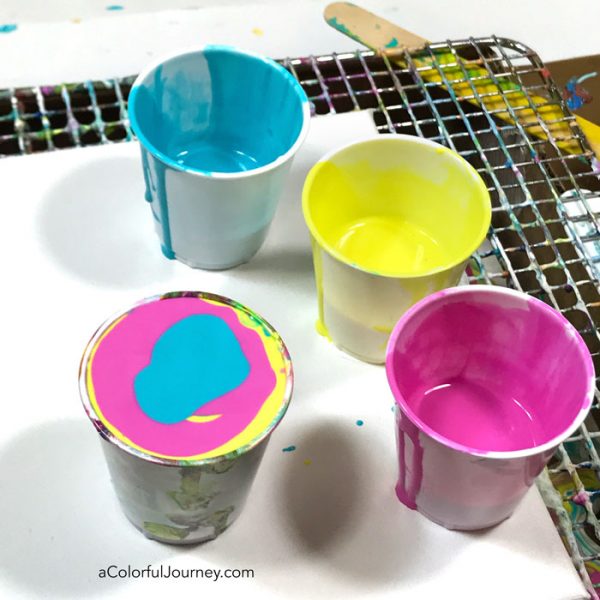
To make a dirty pour, you layer color in a cup. The more layers you have, the more intricate the pour. I’m using 3 colors and white and just kept alternating the colors until the cup is full. The white I’m using has a bit of silicone added to it.
The silicone helps make cells. I only added it into the white. There are 14 drops of silicone to 8 ounces of the white paint/pouring medium mixture. That’s what you see me adding with the squirt bottle in the video. Making dirty pour layers is a breeze with the paint in those condiment squeeze bottles.
Starting Your Pour
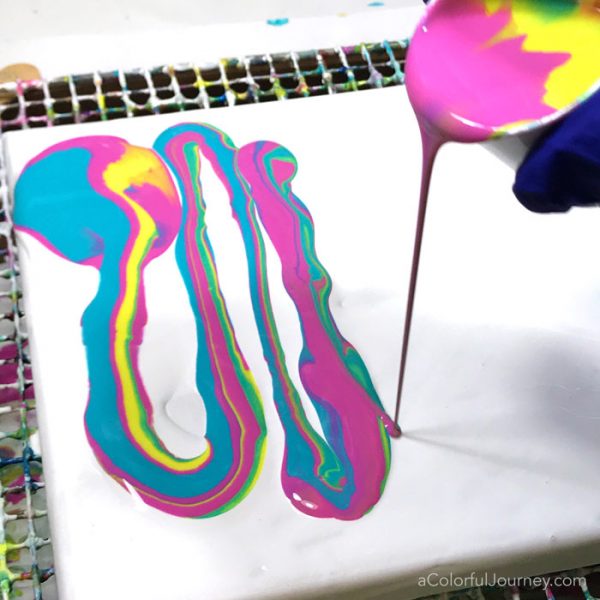
Coat the canvas top and sides with the white paint/pouring medium. Then add the rainbow from the cup. I’m using what I call the San Francisco method of pouring the paint because it reminds me of Lombard Street. You might have seen that winding road with very tight curves.
Once the paint is on the canvas you have a choice. To leave it just the way it is or to mess with it. I chose to mess with it by tipping it and letting gravity pull and stretch the color.
Letting it Dry
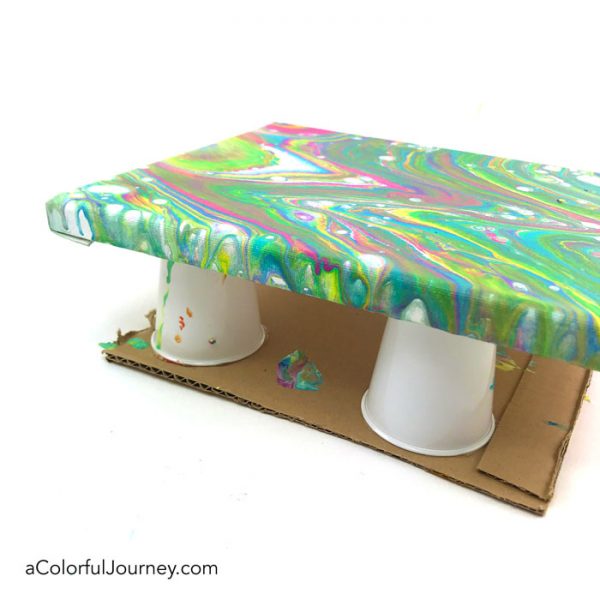
Once you have it how you like it, then let it drip for 15-30 minutes on the rack, then the move it to a homemade drying rack. DO NOT LET IT DRY COMPLETELY on the rack. It will stick. Trust me, it will really stick. How do I know? I did it once and had to almost pry it off with a crowbar.
So I built a drying rack for the next one. It’s not fancy but it gets the job done. Just 4 cups hot glued to cardboard in the width of the canvas. This allows the edges to not touch a thing as they dry and it frees up the main pouring rack and box so you can keep on making more poured canvases while this dries.
It will take anywhere from 12- 48 hours to dry, possibly more depending on how much paint was used. Keep it away from wind, like ceiling fans, and extreme temperatures so that it can dry naturally indoors.
Yes, I’ve tried to speed up the drying process and it was epic failure every time. So now I am just patient and let it dry at the pace it wants.
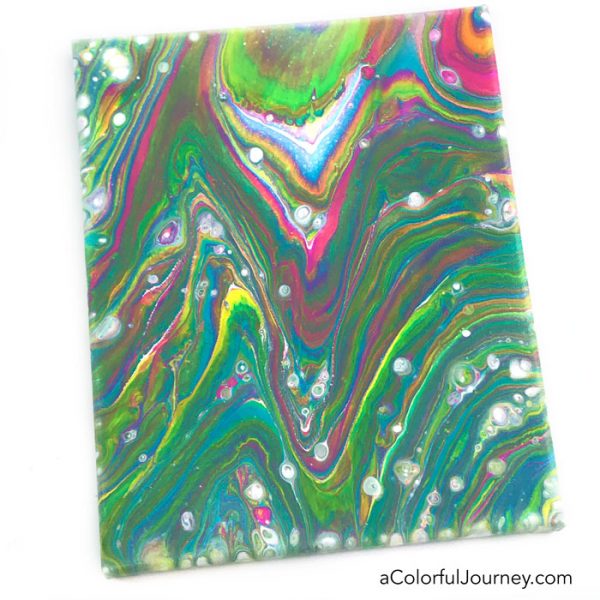
Here’s the canvas completely dry. When did all those white cells happen? Those appeared as it was drying thanks to the silicone in the squirt bottle of white.
Every drop of paint wasn’t used to make this canvas. There is still paint in the cups and a bit of the dirty pour too. What will I do with it? I’ll make another canvas and you bet I’ll share the video.
That video is up and you can see how it made a completely different look for a canvas here.
Want more help getting started paint pouring? Want to know how much paint to use? To understand the ratios and amounts needed to get the looks you love?
Want more help getting started paint pouring? Want to to have it all broken down step by step? Want to understand the ratios when mixing paints? Want new techniques for pouring? You’ll get all of these answers and more in Paint Pouring FUNdamentals, an online workshop.
Here’s what student Teresa Reeves said about the worksop: I really wobbled on paying for this class, wondering if I could pick up most of what I needed to know from you tube videos. I have to say I am glad I paid for this! You make your videos with tons of info and interesting.
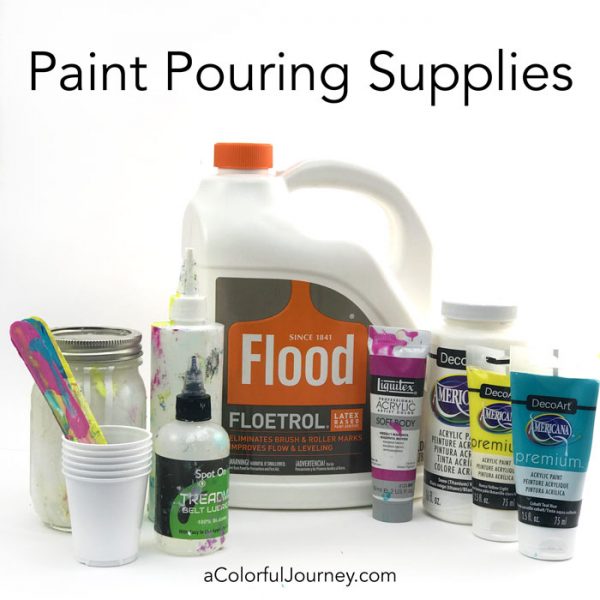
Supplies for this pour
A canvas ( I used an 8 x 10 size)
Something to catch the drips (disposable roasting pan from the grocery store, cardboard box with cooling rack on top with a teflon sheet on the bottom, or any other way you like to catch the drips)
Red, yellow, blue and white acrylic paint. I used a bright pink, cobalt teal, and bright yellow as my three.
Floetrol Latex Additive Pouring Medium- this helps the paint move around the canvas and helps it dry without cracking or crazing. Color was the best indicator of how happy I would be with the ratio of pouring medium to paint. When I mix the paint, if it looks lighter than what comes out of the tube, I add more until it matches.
Condiment squeeze bottle
Silicone oil- this helps with cell formation- 14 drops in 8 ounces of paint/pouring medium mixture.
Cups and popsicle sticks for mixing
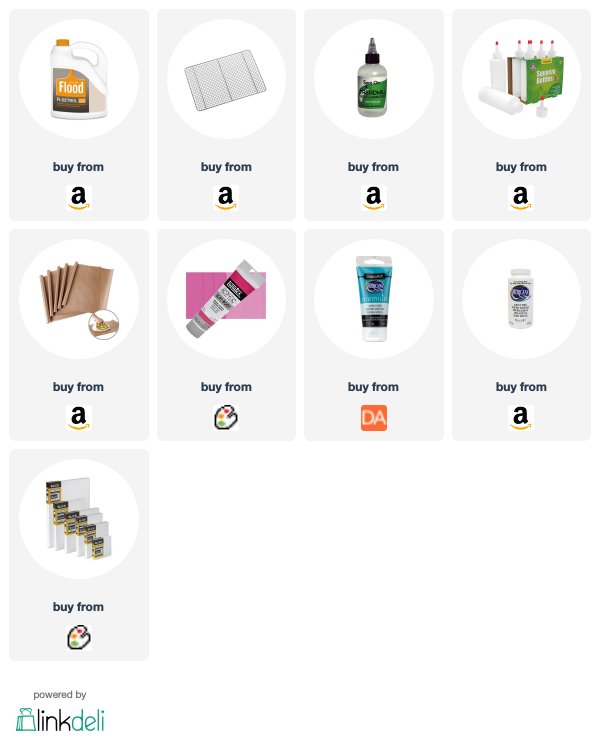
Here are the supplies used. Some of these links are affiliate links which means I get a small percentage. It doesn’t cost you anything extra and it helps keep the free tutorials coming!
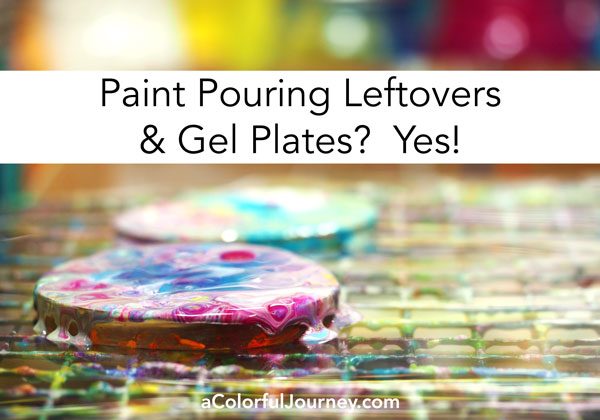
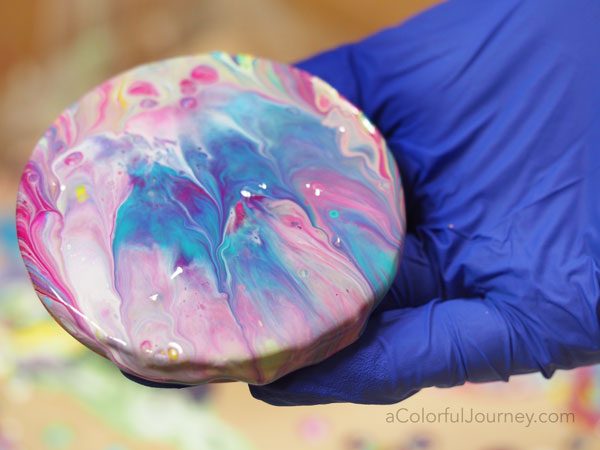
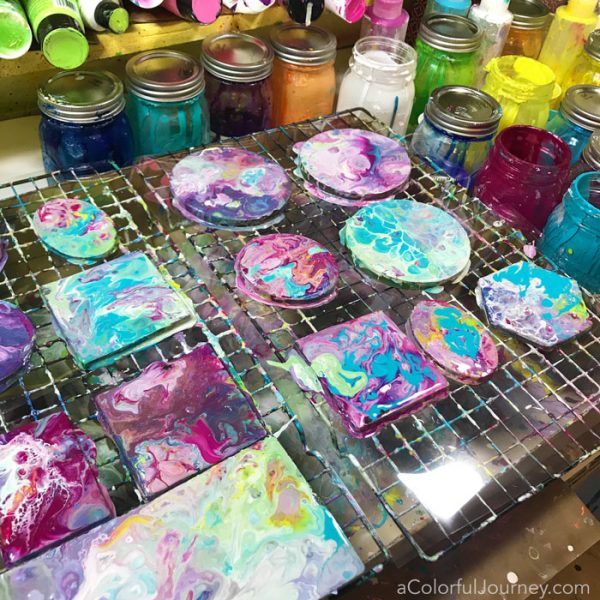
What can you do with leftover paint that drips off canvases when doing acrylic paint pouring? Capture all that colorful pattern with gel plates and make acrylic skins. The gel plates capture each and every detail!
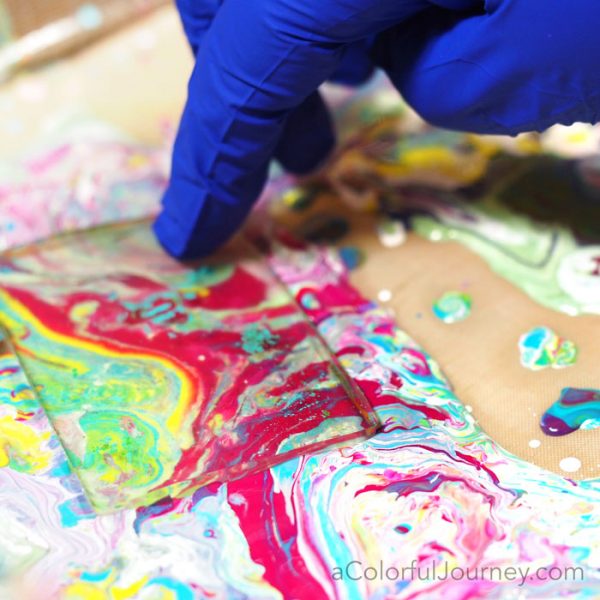
Put a gel plate, any size, on the wet leftover paint that collects after making a few acrylic paint pours.
All that detail that you see through the plate there will be there when the paint is totally dry. This technique works best with gel plates that have lots of squish to them, like the Gel Press plates.
The backside won’t look anything like the front and don’t worry about that. All the detail is still there on the other side.
If you happen to have any bare spots show up within a few minutes of dipping the plates, simply scoop up bits of the remaining paint in the box to fill those in.
When dipping these in the leftover paint, be aware the paint tends to get all over the place. I peel off the plastic protective covers that I store them in and put them on transparency sheets for a laser printed from an office store while they dry. That way none of the dripping paint gets on my heavier weight protective plastic covers that came with the plates.
The paint needs to be completely dry before you pull the skins off. In this case it meant 24 hours. The temperature where you live, how much paint is on there, and what kinds of paint you used all impact drying time. It can take a while but this only works if the paint is completely dry before you peel it off the plate.
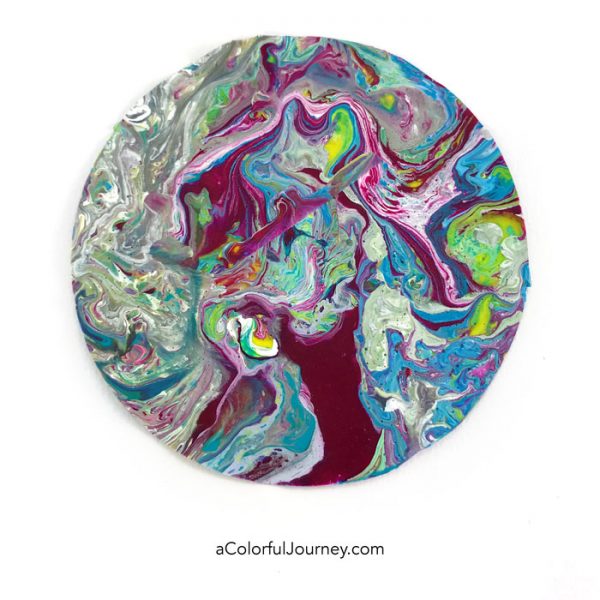
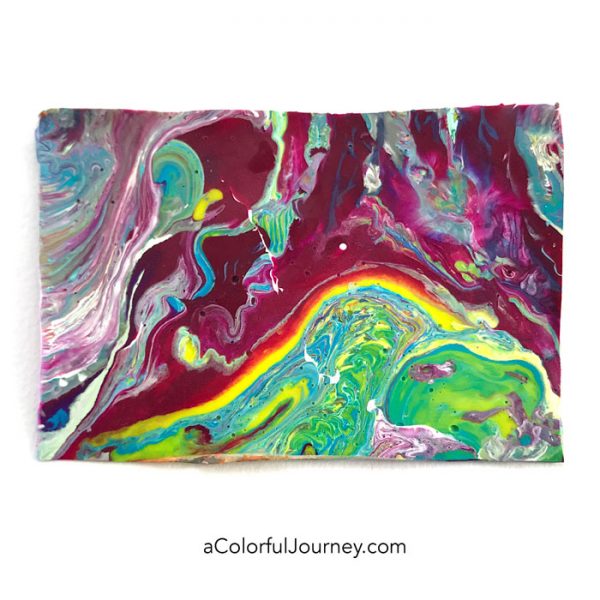
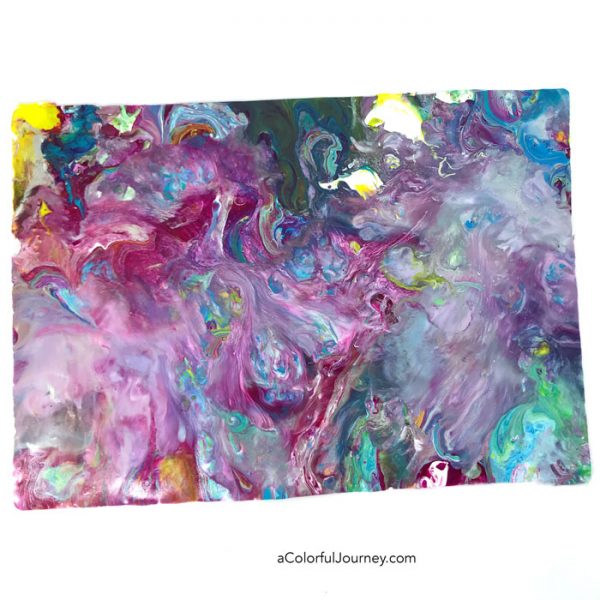
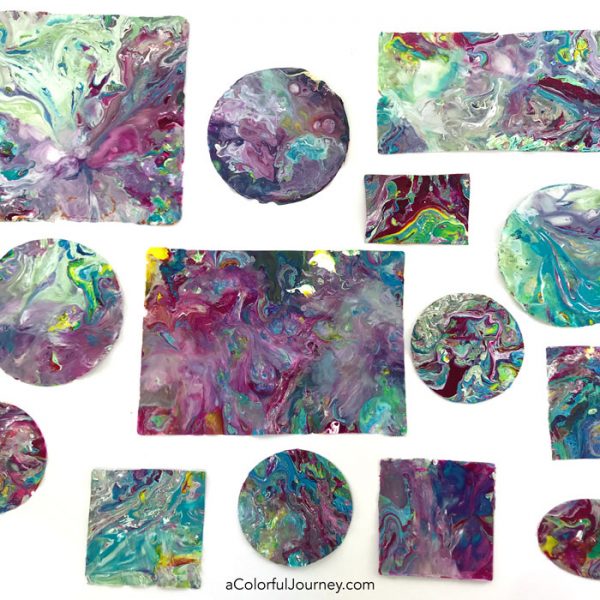
Here’s what they look like when completely dry. Whatever details were in the paint are captured in the acrylic skin, the dried paint peeled off the gel plate.
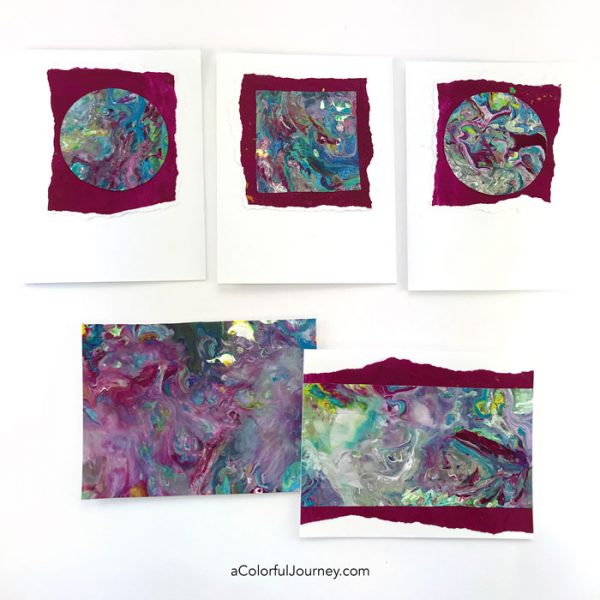
I used several of these skins to make quick colorful cards. Skins can also be used for collage, art journaling, and any mixed media fun you want!
Here are the supplies used. Some of these links are affiliate links which means I get a small percentage. It doesn’t cost you anything extra and it helps keep the free tutorials coming!
This website uses cookies to improve your experience while you navigate through the website. Out of these cookies, the cookies that are categorized as necessary are stored on your browser as they are essential for the working of basic functionalities of the website. We also use third-party cookies that help us analyze and understand how you use this website. These cookies will be stored in your browser only with your consent. You also have the option to opt-out of these cookies. But opting out of some of these cookies may have an effect on your browsing experience.
Necessary cookies are absolutely essential for the website to function properly. This category only includes cookies that ensures basic functionalities and security features of the website. These cookies do not store any personal information.
Any cookies that may not be particularly necessary for the website to function and is used specifically to collect user personal data via analytics, ads, other embedded contents are termed as non-necessary cookies. It is mandatory to procure user consent prior to running these cookies on your website.

 The leftover paint in the bottom of the cup from a dirty pour is an invitation to make another canvas. Plus it feels criminal to not use that gorgeous color mingling in the cup. So I just have to make another canvas. Can you see the muse twisting my arm and forcing me to play?