
≡ Menu

What’s the play for today?  It’s art journaling in the giant, jumbo, vintage ledger- which finally has a name!  As I’m painting the page and tree, you’ll see why acrylic gouache was so handy plus how the Scribble Scratch stencil made leaves on the tree too.

At the end of the video, you’ll see how to deal with a logical left brain squashes the play.

Watch Using Acrylic Gouache in an Art Journal on YouTube.

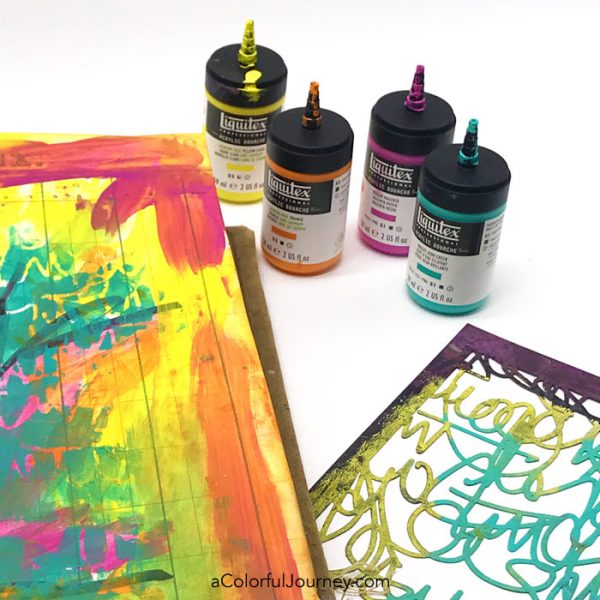
Acrylic gouache is a combination of watercolor and acrylic paint.  So if you add water, it behaves like a watercolor and spreads over large areas easily.  If you use it straight from the bottle, it behaves more like an acrylic paint.

Once it is dry, it is permanent so it makes it great for layering in an art journal.
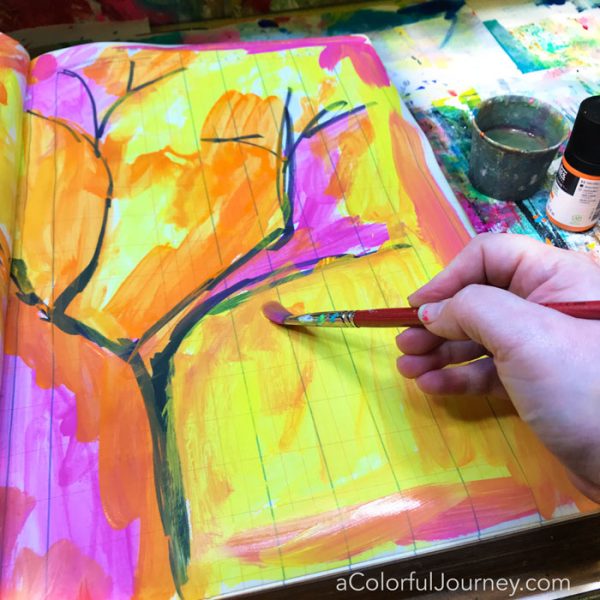
What stencil is making the leaves?  That’s Scribble Scratch, one that I designed for StencilGirl. There are no leaves on it, but that doesn’t matter one bit.  It’s going to make great impressionistic leaves!
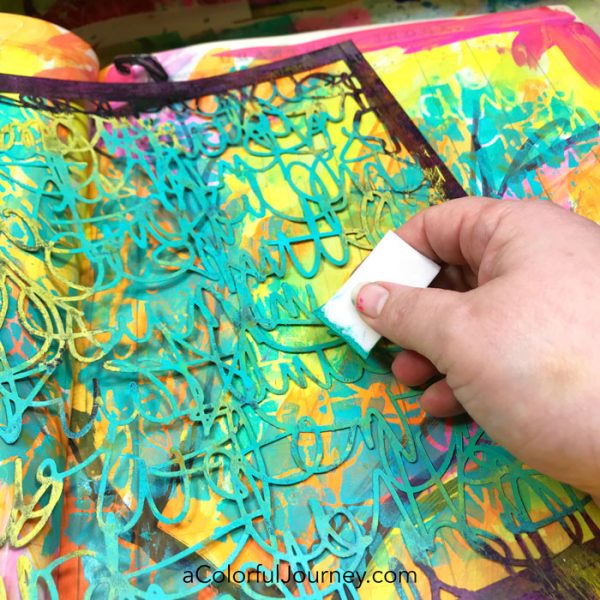
The final touches to the tree came courtesy of the all-purpose studio supply, the baby wipe.

After the tree was finished, my logical left brain started to ask a lot of questions.  Questions like, what will you add next?  How are you going to finish it? Being pestered and hounded by these questions was taking the fun out of the play.

I not so politely reminded that logical left brain that just because I start a page does not mean that I am required to finish it that same day. And I stepped away from the page.

If you leave it be, step away, and come back with fresh eyes often it’s clear what you want to do next.  What you’re doing is taking the pressure off which makes it a whole lot easier to play!
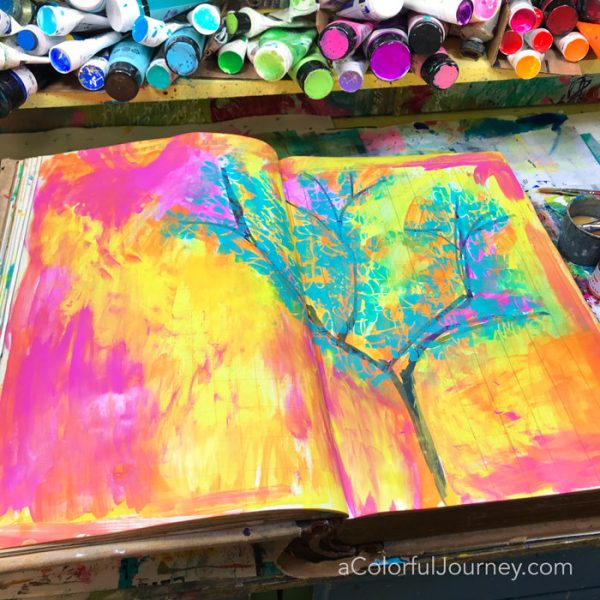
So what is the name of this big journal?  It’s been a long journey to decide and I so appreciate all the help, suggestions, and ideas that have been shared with me.

It was easier for me to name my children than this book- but I finally have it. MoJo.  It means 2 things to me.  First, Mother of a Journal- this thing is huge. Second, it’s where I go to play when I need to get my mojo back.

Thanks again to everyone who shared their ideas for a name!

Here are the supplies used. Some of these links are affiliate links which means I get a small percentage. It doesn’t cost you anything extra and it helps keep the free tutorials coming!
{ 8 comments }

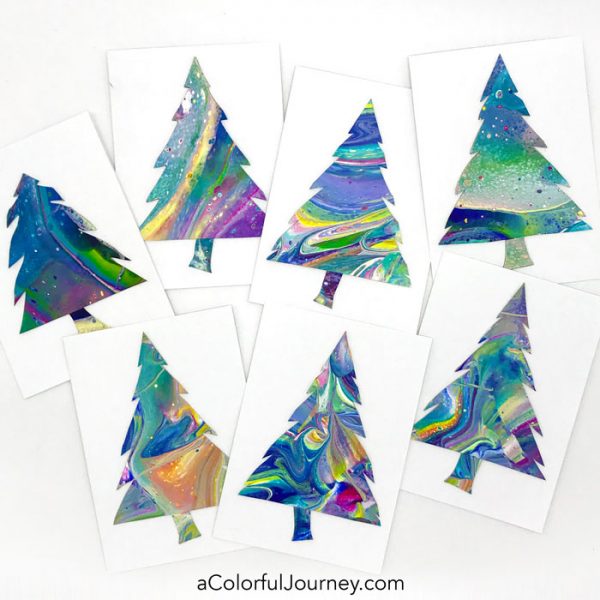
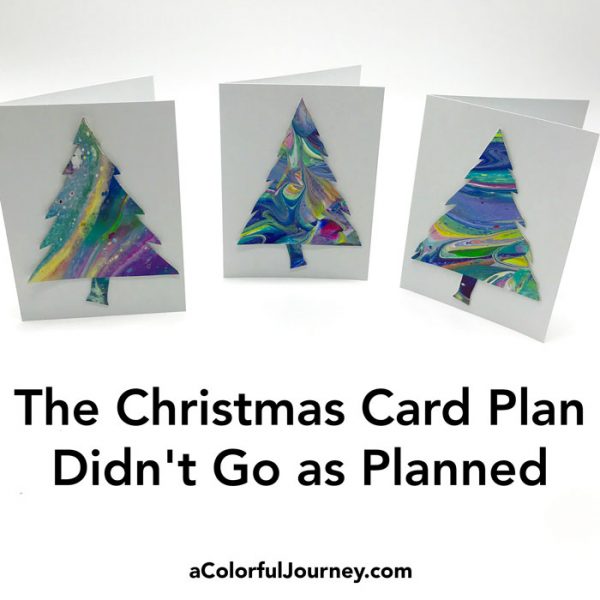
Handmade Christmas cards.  I wanted to send them this year, and I had a rock solid, easy to make, guaranteed to work plan in my head! Easy to cut, quick to make.
You know what that means- things definitely won’t follow the plan!  And then there was the over thinking. Oh, was there over thinking! O.O.P.S.!

Watch on YouTube.

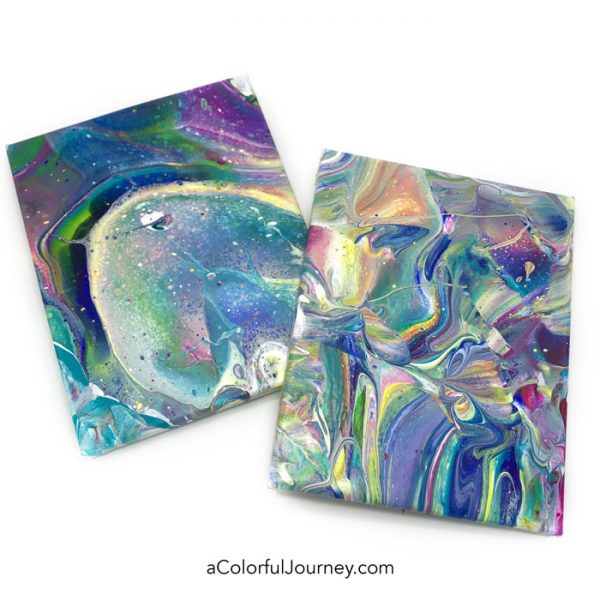
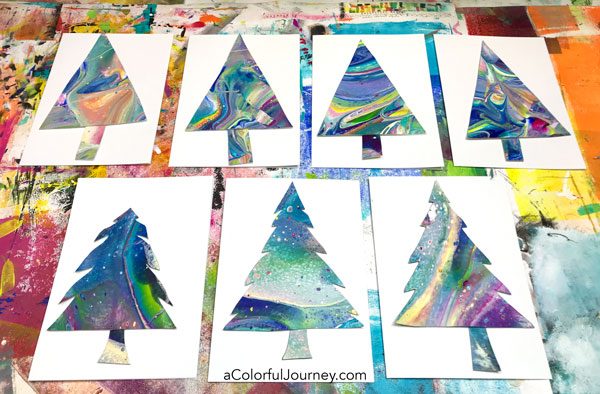
What made the colorful patterns on the trees? Paint poured canvases, after all, they can do far more than only be hung on your wall- they can be used to make things like cards!
 
Want to understand paint pouring and know exactly how to do it the easy way? Check out my online workshop Paint Pouring FUNdamentals.

Start by cutting the canvas off the frame using a craft knife.  The sharper the knife, the safer it actually is since dull knives take more effort to cut and hence are more likely to slip. Be safe and use a fresh blade. Okay, that’s the public service announcement for this blog post.

The plan was to cut a simple triangle shape to be a tree.  But as you can tell, that plan didn’t last long.

I started adding more of a branch look to the edges, and in the video, you can see how one looked like a poop emoji before it became the Charlie Brown Christmas tree.

And yes, there was way too much thinking going on about the tree shapes. More than one pattern was attempted before I just decided to stop thinking and start cutting! Yup, that’s in the video too.

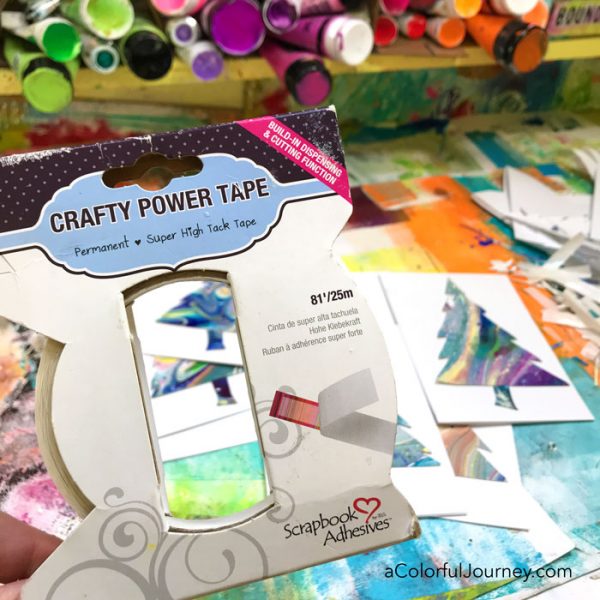
To attach them to the canvas, I usually use a glue stick. Except that I am totally out of glue sticks.  I don’t like to use gel medium for this as it tends to warp the paper a little bit so I reached for the double-sided tape.

But not any tape, there is something special about the Crafty Power Tape that made it work better on the canvas.  The backing paper that you peel off is larger than the tape, so that means it is much easier to remove.  That’s important when putting tape on canvas because any double-sided tape has a tough time sticking to canvas.

I have to laugh at myself because the O.O.P.S. tree, that Charlie Brown tree, has really grown on me and now might be my favorite!  Once again, a “mistake” takes me somewhere even better than I had planned!

If you’re new to my play, an O.O.P.S. is an Outstanding Opportunity Presenting Suddenly. I make all sorts of OOPSies and you can see more of them here.

{ 12 comments }

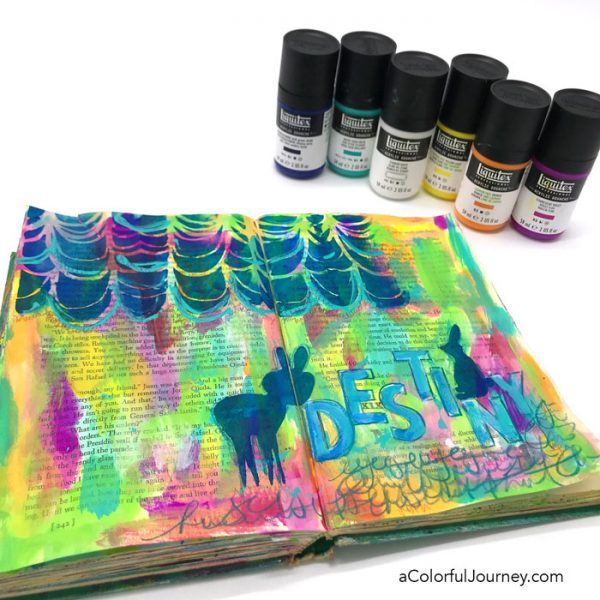
If watercolors and acrylic paint had a love child, it would be acrylic gouache.  It’s like taking the best qualities of both and then putting them in the best bottle ever for mixed media play.
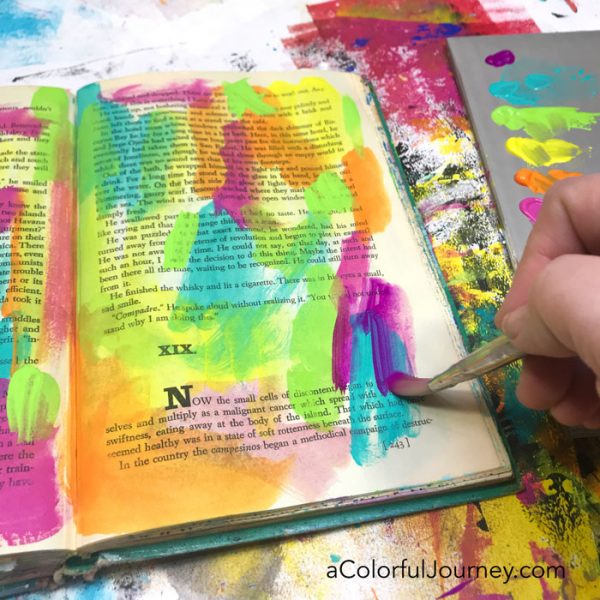
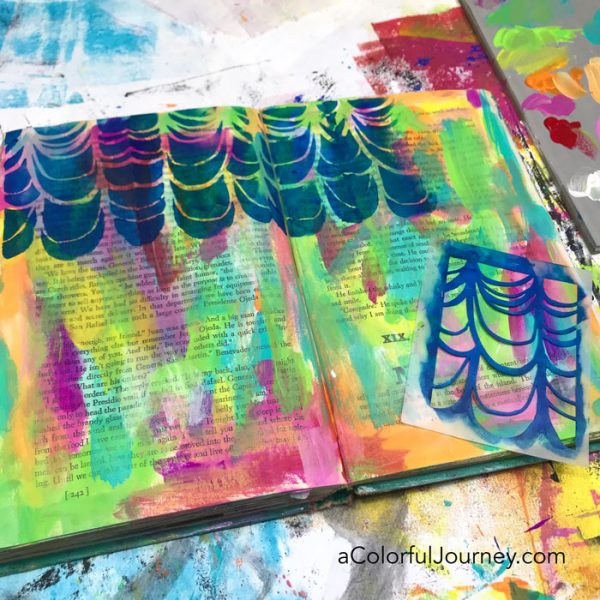
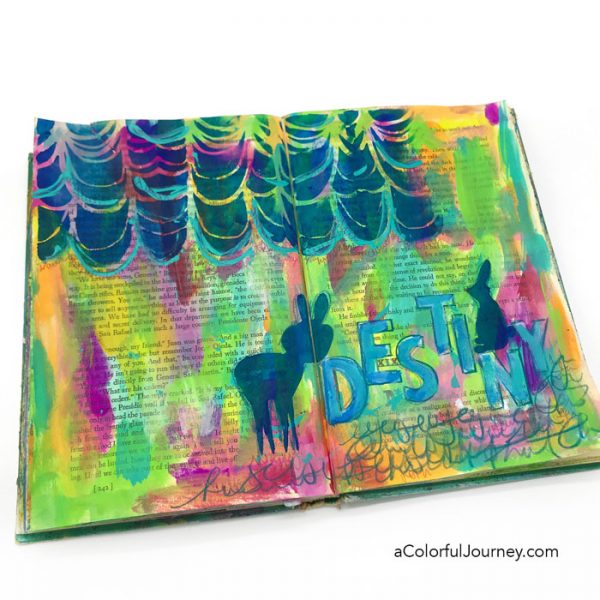
I’m putting this new paint from Liquitex through its paces as I make this art journal page.  I found out how colored pencils write on it, how well it stencils, how well it paints, and then there was the game changer that I figured out at the very end.  Hint- it has to do with using pens on it.

Watch What is Acrylic Gouache & How Do You Use It? on YouTube.

Acrylic gouache has some characteristics of watercolors so that means you can add water to it without quickly getting that watered down look. If you use it a full strength, the way it comes out of the bottle, it is more opaque.

How does it work with stencils? Just a little drop of blue paint and a cosmetic sponge did all of this stenciling with Mary Beth Shaw’s ATC stencil.

This paint dries quickly so that means when I used the stencil repeatedly, even flipping it over, there weren’t any unexpected smears of paint.

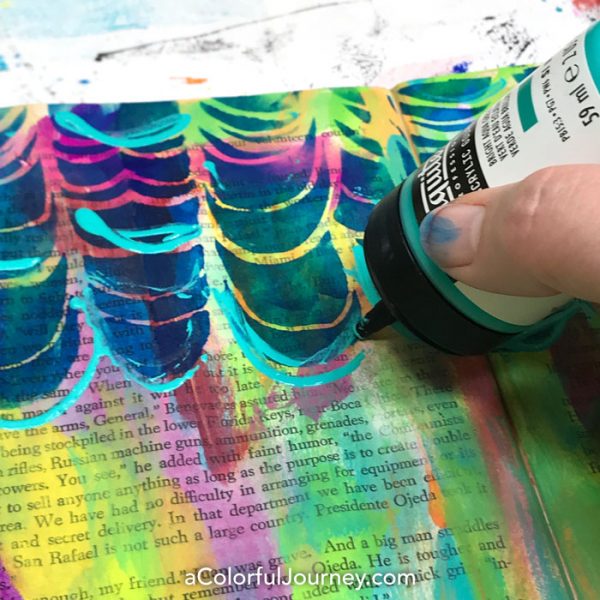
The shape of the bottle made me wonder if it would write and it did!  It’s like a loose paint marker.  How hard you squeeze the bottle determines how much paint comes out.

And if you unscrew the top, it has a big opening so that you can get a brush in there and get every bit of paint out.

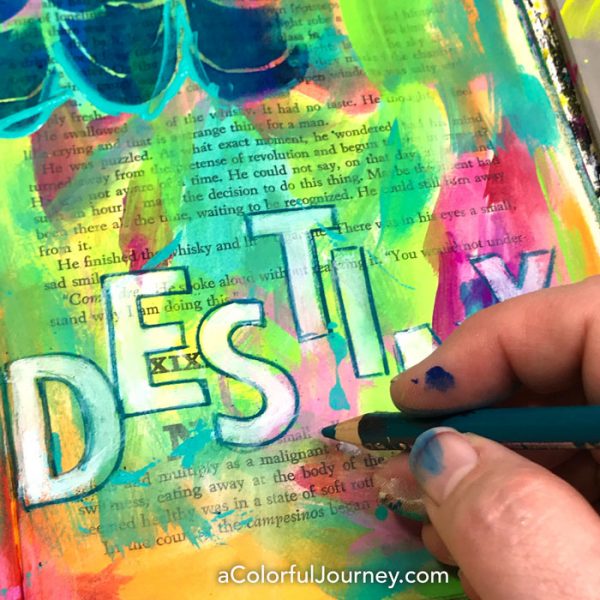
Will colored pencils write on it?  Yes!  I traced the word with a colored pencil using my Open Ended alphabet from StencilGirl. The pencil wrote easily over the paint.

To make coloring in the letters easy, use a brush that is just a little smaller than the letters, like a size 6 filbert.

O.O.P.S. How I spaced the letters did not go as planned. I really wanted the D in Destiny to be farther to the left.  End of the world?  Nope.  Just an Outstanding Opportunity Presenting Suddenly.
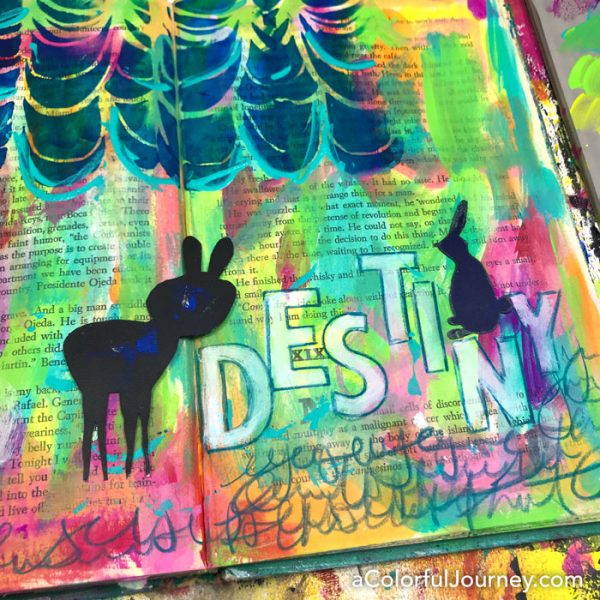
Without this O.O.P.S., I never would have used the Figments of Imagination stencil and mask set.  One of the perks of having a set like this is you can audition where you want to put your creatures before committing with paint.

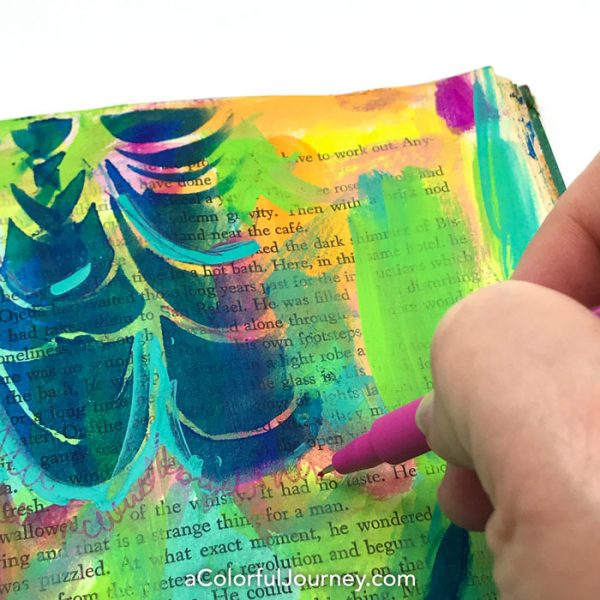
The big game changer for me was when I tried to write on it with a fine tip pen. Many a pen has come to an untimely end at my hand because of writing on dry paint.

Yes, the dry paint would clog up the fine tips. But one pen volunteered for the dangerous experiment to see if pens would work on this paint. That pen lived!  It worked!

But I didn’t fully believe it, so I risked another pen, just to be sure. That pen lived too!  I haven’t done a long-term study on this but I am willing to use my pens on the acrylic gouache because if these 2 super fine tipped Pitt pens can survive, then I bet any pen of mine can.

This paint can be opaque, can be more like a watercolor, colored pencil write on it, works with stencils, and even pens can write on it. The only thing it doesn’t do is slice and dice.  Okay, maybe I have seen too many Ginsu knife infomercials.

Here are the supplies used. Some of these links are affiliate links which means I get a small percentage. It doesn’t cost you anything extra and it helps keep the free tutorials coming!

The pens used were Pitt pens.


{ 13 comments }