
≡ Menu

What’s the best way to paint pour? That’s the question my dear friend asked me as we were about to start paint pouring.  I had all the supplies on the table for us and she had question after question.  She wanted to know the best way to add the paint to the cup, the best color combinations, the best pouring medium.

I broke the news to her that there wasn’t any one best answer and that is part of what makes paint pouring magical.  There isn’t a big book of must follow rules.    Instead of rules, it’s more about guidelines. In the video, I’m sharing the technique that I showed her for her first pour.

Watch on YouTube.

Which pouring medium?  Any one you like. They are all fun for making pours.   In the video I am using Floetrol, which can be found at a hardware store and is the cheapest.  It is the one I have found students have the most fun with starting out since it makes cells.

But how much pouring medium?  Start with a ratio of 2 parts pouring medium to 1 part craft paint.  This is a very forgiving process, so you don’t have to be exact. It’s a guideline not a rule after all. You can see how to mix paint and pouring medium in this video.

Which colors? Ones you like in any brand of paint. You probably already have paint that will work wonderfully well.  The only thing I stay away from is super thick paint, the kind that comes out of the tube like toothpaste.  It’s just harder to mix with the pouring medium.

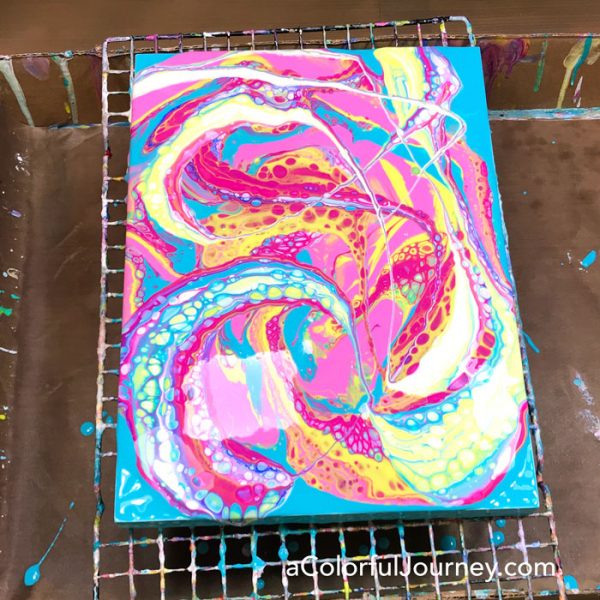
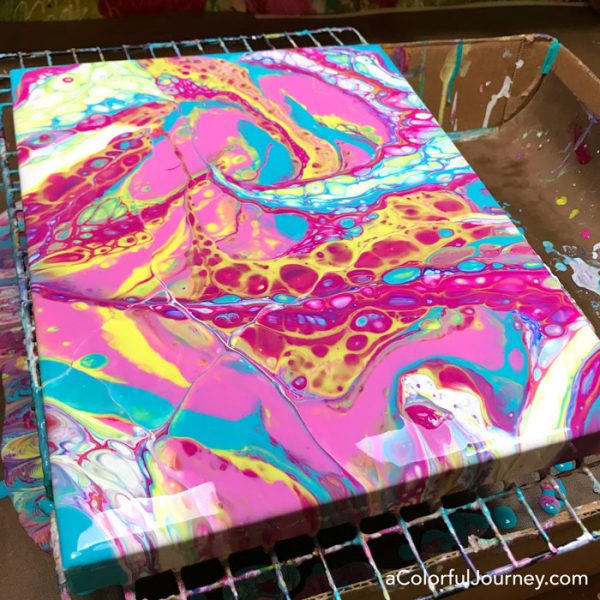
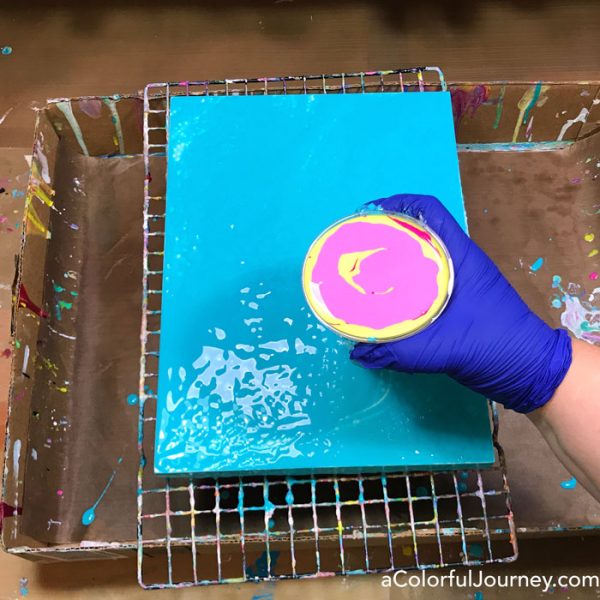
You just pour that paint from the cup all over the canvas.  No thinking, no careful planning, just letting go and trusting. You can pour as little or as much of the cup of paint on the canvas.  It’s not like there are rules that you must follow.

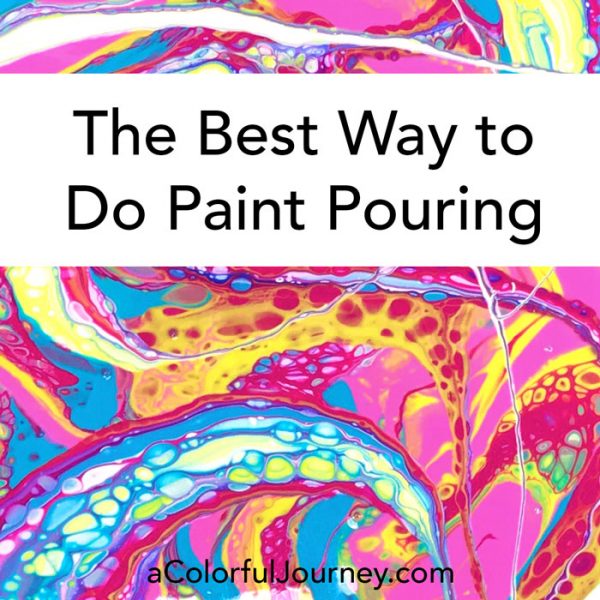
As it dries, the paint might still move a bit.  That happened here and it brought the most wonderful surprise!

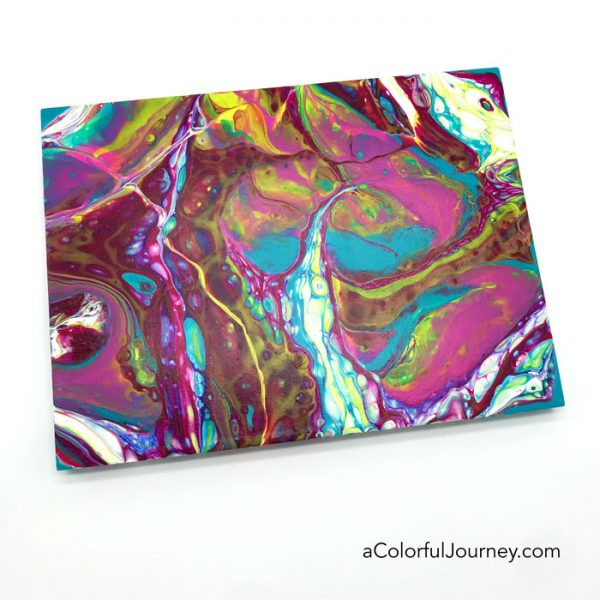
Every so often a face appears and when it does, I treasure it!  Especially when they are so groovy and fun like this one!  This isn’t something I planned or “made” happen, it’s just a gift of the serendipity of the paint.

Why is the paint darker once it was dry? During the drying process the color of the paint can sometimes darken.  There are several factors that make that happen and the main one here is the paint that I chose to use.

I helped my friend get comfortable quickly with paint pouring and I can do the same for you. Join me for Paint Pouring Palooza in Cincinnati and let the rainbow flow onto your canvases!

{ 7 comments }


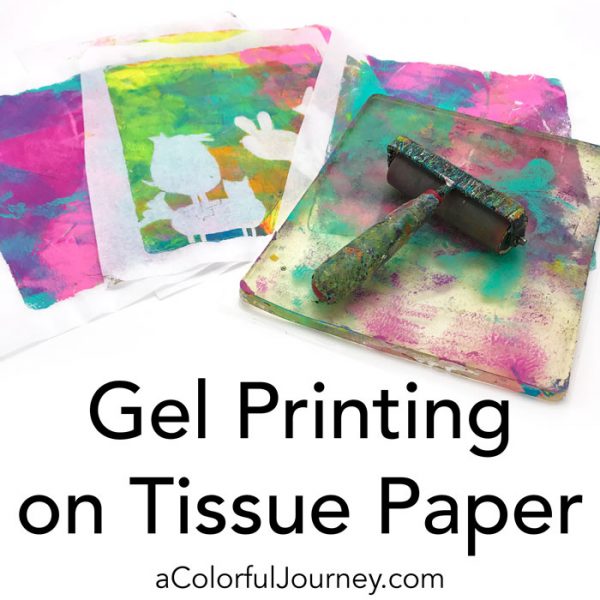
Can you use tissue paper to make gel prints? Absolutely!  It’s paper and paper works on a gel plate!  There is one important thing that if you know it, even when you have a juicy wet gel plate it is easy to print away on tissue.  In the video, you’ll see when it ripped for me, and it wasn’t when you’d expect it to rip!

Watch How to Gel Print with Tissue Paper on YouTube.

Find out more about Gel Printing FUNdamentals mentioned in the video.

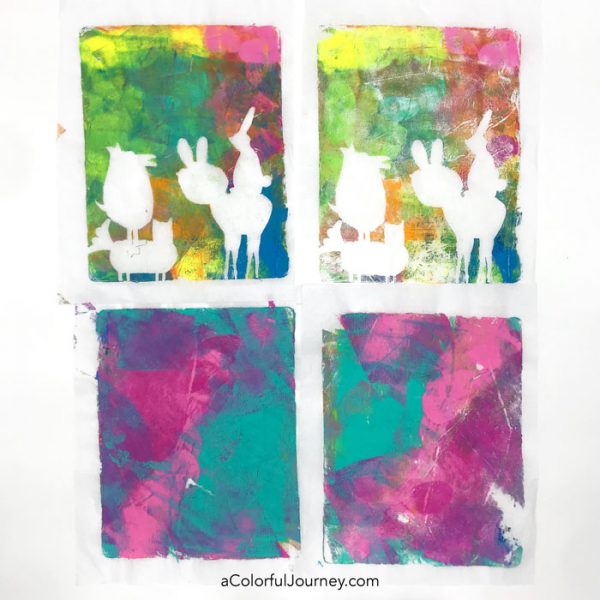
Why use tissue paper? It’s super thin and if you leave bare spots, it can make for fun layers in an art journal. That’s what I’m using my Figments masks for, to leave a portion without any paint.  I’ve got an idea for how I’ll be using it in my art journal and you bet I’ll have a video of it.  Be sure to be subscribed to my newsletter so you’ll know when it’s posted.

How did I choose what tissue paper to use? It’s not because it has special qualities, it’s a practical reason.  I wanted tissue paper I could have in sheets without the folds in it. This comes in 12 x 18 sheets that are completely flat so I just cut them in half and voila! They are ready for printing.  And I think it’s funny that the image on their site has colored tissue but it really is all white, just be sure that the description when you order says white.

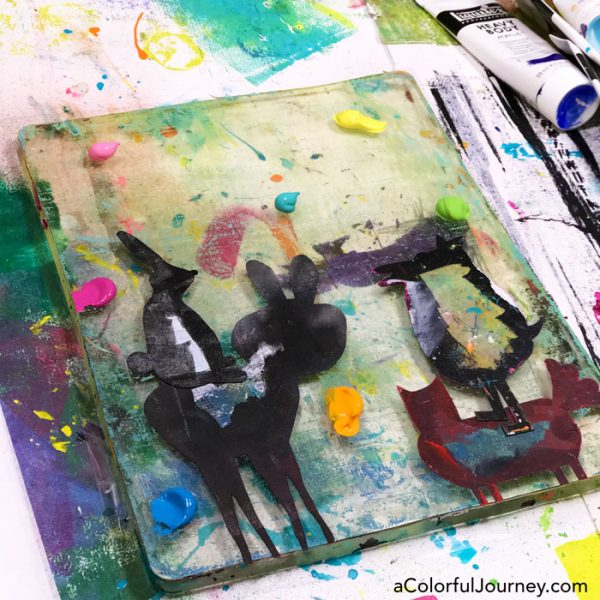
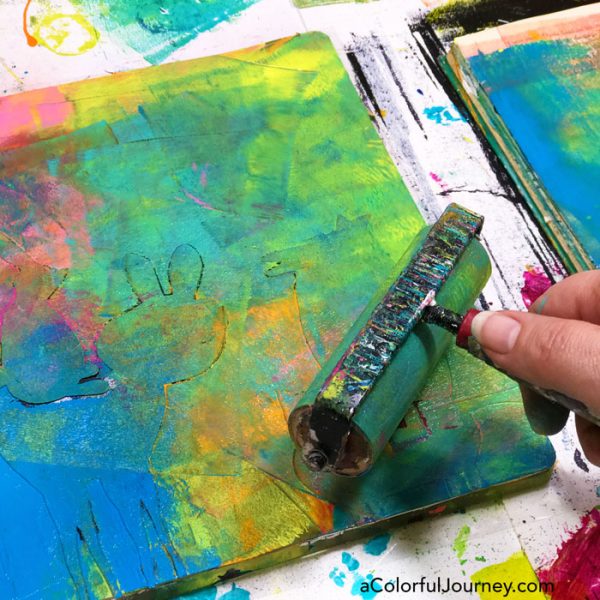
Brayer the paint around the gel plate and then lift up the Figments masks.  These masks are included with the stencil, so you get 7 masks and the stencil in the set.

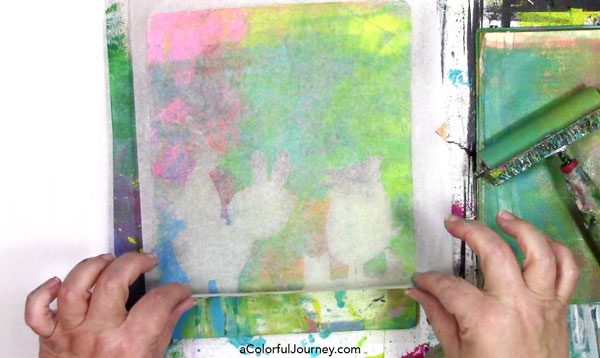
Gently place the tissue paper on the paint.  Lightly smooth it out to be sure the tissue paper is touching the paint. After all, if it doesn’t touch the paint it won’t pull up the paint there.

Grab the tissue paper with both hands.  Lift with both hands. This will allow it to lift and not rip. You can use just one hand, but that makes the paper harder to handle once it is off the plate.

No matter how much paint I used, and some of them were super juicy, the tissue paper didn’t rip when I pulled it off the plate.  I did however manage to rip the paper bumping into a box with it as I was trying to find a place to set it dry.

The secret to delicate tissue paper coming off the plate? Leaving a dry edge around it, so that when you are picking it up, you are holding on to dry tissue paper.

Now that you know what the fundamentals are about tissue paper and gel printing, it’s much easier to print with it. Understanding the fundamentals makes things easier.

If you’d like to know more fundamentals about the gel plate, check out my self paced online workshop that is all about understanding the how the magic happens when printing so you can make prints you love.

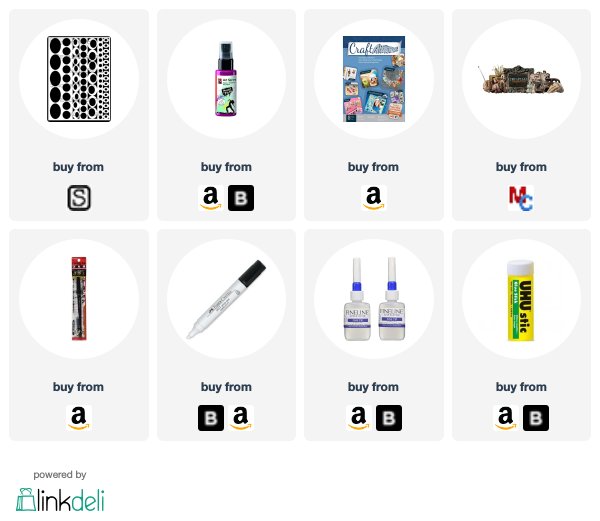
Here are the supplies used. Some of these links are affiliate links which means I get a small percentage. It doesn’t cost you anything extra and it helps keep the free tutorials coming!
{ 4 comments }

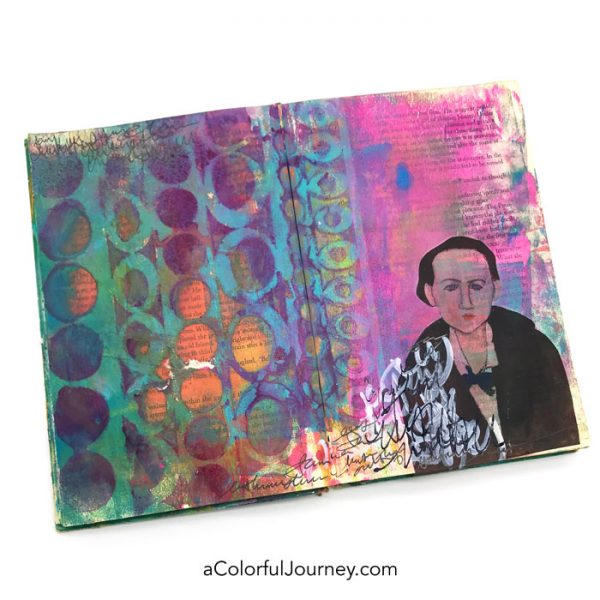
Let’s chase away the blank page and say goodbye to all the pressure that can accompany that blankness, by gel printing directly in the journal.   Why do I love to start an art journal page this way? Is it because every drop of paint is used?  Is it because there is zero pressure? Is it because it’s exciting to see the colors mingle? Yes to all of them!

Watch Gel Printing, Stamping and Mousse in an Art Journal on YouTube.

If you’re looking for more ways to use your gel plate, to play with the rainbow and never make mud, and to have fun printing then check out the self paced Gel Printing FUNdamentals.

What’s that texture tool I used to make the pattern? It’s textured wallpaper.  What can you do if you don’t have that lying around? Have any of those embossing folders? Those will create a raised pattern on the paper that you can use just the way I did the textured wallpaper.

The gel plate was my “ink pad” for stamping.  And by ink pad, what I mean is a place to put the paint so that not a drop is wasted.  The paint left of the plate after I was done stamping was used to make prints.

The ghost print made me extremely happy but what about the other print?  It didn’t rock my world.  That happens sometimes.  But I’m keeping that print because I know it too will become one I love.  How I build up layers, the decision process for how to transform ho hum prints into something so much more is all a part of Gel Printing FUNdamentals.

Once it is stamped, then it is time to cover up the background with a touch of white.

If you’re wondering how to carve a big stamp, I’ve shared my process in this video.

On top of the white paint is white Mousse. What is Mousse by Marabu? It is like a texture paste with a fine grit to it that dries in a few minutes.  I used white and put it through my Rembrandt’s Words stencil . White on white is tough to see.  But it wasn’t going to be white for very long!

By going over it with an Art Crayon, the Mousse was grabbing the color.  Art Crayons react to water, so using a baby wipe, the color blends and smears and moves easily. It’s so creamy that you can also just use your finger to move it around too.

In the video, you’ll see the “struggle” I went through to cover up this background. It always adds an extra bit of excitement for me when part of me wants to keep something and part of me wants to cover it up.

Of course, nothing is every really fully covered, like here where the background peeks out from around and under the pink.

Here’s where I stopped playing today because of the Art Crayons.  Right now they are creamy but if I give them some time to dry, they will become matte.  That means things like colored pencils will be able to write on them.  Love that it can be creamy to start then matte when dry because it gives me so many options for how to use it!

Now you know one of the ways I deal with the blank page so next time you feel any pressure from a crisp, new page, grab your gel plate and get that color on there!

Here are the supplies used. Some of these links are affiliate links which means I get a small percentage. It doesn’t cost you anything extra and it helps keep the free tutorials coming!
{ 4 comments }